
Introduction
Mexico is one of the most important manufacturing markets for companies serving North American customers.
But for 2026 workforce planning, the advantage is not just Mexico’s proximity. It is Mexico’s ability to support structured workforce execution across hiring, payroll, compliance, onboarding, benefits, and operational continuity from day one.
For companies planning production, assembly, warehouse, logistics, quality, maintenance, or supply chain support teams, Mexico belongs in the workforce plan for 2026.
Mexico’s Manufacturing Strength Is Already Established
Mexico is not an emerging experiment for manufacturing. It is an established industrial market with proven capability across production, assembly, automotive, electronics, aerospace, medical devices, logistics, and advanced manufacturing.
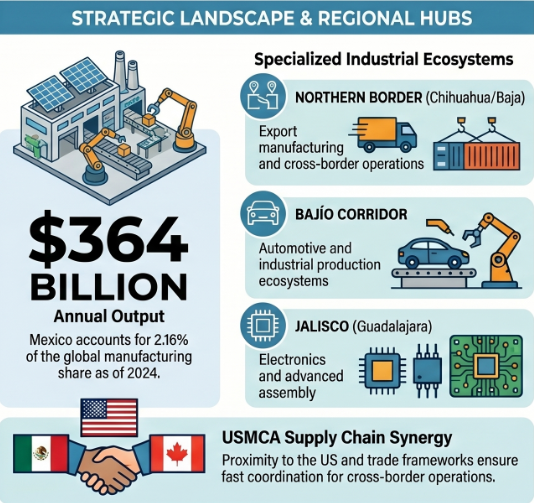
According to Safeguard Global’s manufacturing workforce analysis, Mexico’s global manufacturing output in 2024 was listed at $364 billion USD, representing 2.16% of global manufacturing share. The same analysis also notes that World Bank data reported manufacturing value added at 19.64% of Mexico’s GDP in 2024.
Manufacturers today are not looking only for lower-cost locations. They are looking for markets that support both workforce scale and operational maturity.
Mexico supports both high-volume workforce needs and specialized operational roles across quality, maintenance, supervision, warehousing, and supply chain support.
Why Mexico Fits North American Workforce Planning
Manufacturing companies are under pressure to reduce delays, strengthen supply chain responsiveness, and place teams closer to the markets they serve.
Mexico supports this shift through geographic proximity, time zone alignment, and strong connection to North American trade.
The United States-Mexico-Canada Agreement (USMCA) continues to strengthen trade, operational integration, and workforce collaboration across North America.
For manufacturers, this creates a practical workforce advantage. Teams in Mexico can collaborate more easily with U.S. operations, respond faster to production or supply chain requirements, and support regional business continuity with less time zone friction.
In simple terms, Mexico helps companies move closer to execution.
Mexico Is Not One Uniform Workforce Market
One of the most common workforce planning mistakes is treating Mexico as a single hiring market.
Different regions offer different industrial strengths. The right location depends on the type of workforce a company needs, the industry it operates in, and the operational outcome it wants to support.
Key Manufacturing Regions in Mexico
1. Northern Border Region
This includes areas such as Baja California and Chihuahua. These locations are strongly aligned with export manufacturing, cross-border logistics, and supplier connectivity.
2. Nuevo León and Monterrey
Monterrey is one of Mexico’s strongest industrial hubs, known for operational leadership, industrial depth, engineering-adjacent roles, and advanced manufacturing capability.
3. Bajío Corridor
The Bajío region includes Guanajuato, Querétaro, Aguascalientes, and San Luis Potosí. It is widely recognized for automotive production, industrial operations, and manufacturing supply chain ecosystems.
4. Jalisco and Guadalajara
This region is often associated with electronics, advanced assembly, technology-enabled manufacturing, and engineering-adjacent support roles.
For employers, the key decision is not simply whether to hire in Mexico. The more important decision is where and how to align workforce needs with production, compliance, payroll, and operational requirements.
Why Mexico Matters for Manufacturing Workforce Plans in 2026
Mexico is critical for 2026 because manufacturers are no longer planning around cost alone.
They are planning around speed, compliance, capability, and continuity.
1. Mexico Supports Workforce Scale
Manufacturers can use Mexico to build teams across production, assembly, warehouse operations, logistics, maintenance, quality, and operational support.
This is important for companies that need to ramp up teams while maintaining process discipline and delivery consistency.
2. Mexico Supports Specialized Manufacturing Roles
Beyond production staffing, Mexico can support specialized roles connected to quality control, maintenance, technical support, operations supervision, supply chain coordination, and engineering-adjacent functions.
This gives companies more flexibility when building long-term workforce capability.
3. Mexico Is Mature Enough for Structured Planning
Mexico has established employer practices, labor frameworks, and manufacturing ecosystems. This allows companies to build workforce plans with greater confidence instead of relying only on short-term staffing decisions.
Labor and Compliance Factors to Build Into 2026 Planning
Workforce potential in Mexico is strong, but employment planning must be compliance-first.
Manufacturers should account for local labor requirements, compensation changes, benefits administration, payroll obligations, and compliant workforce models before hiring begins.
Minimum Wage Updates
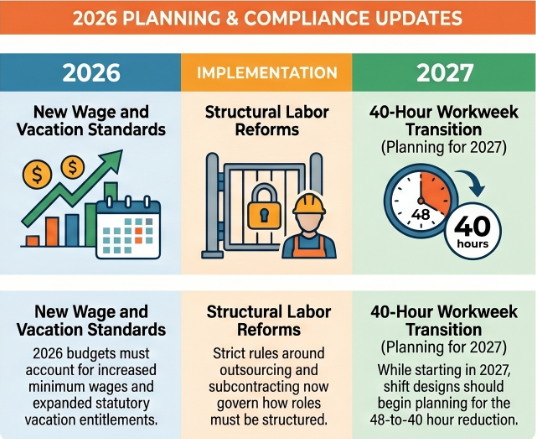
Mexico’s minimum wage rates increased effective January 1, 2026, including separate rates for the general zone and the Zona Libre de la Frontera Norte. These changes must be factored into workforce budgets and payroll planning.
Profit Sharing Requirements
Employee profit sharing, known as PTU, remains an important compliance consideration in Mexico. Mexico’s Supreme Court confirmed the constitutionality of the cap on PTU payments in April 2024.
Outsourcing and Subcontracting Rules
Mexico’s 2021 labor reform restricted personnel outsourcing and tightened subcontracting rules. For companies using staffing partners, specialized service providers, or flexible workforce models, roles must be structured, documented, and governed properly.
Vacation Entitlement Reform
Mexico’s Vacaciones Dignas reform increased statutory vacation entitlements beginning in 2023. This continues to affect leave tracking, payroll planning, benefits administration, and employee policy management.
Workweek Reduction Planning
Mexico’s Congress approved a constitutional reform to gradually reduce the standard workweek from 48 hours to 40 hours, beginning in 2027 and phasing in through 2030, pending state approvals.
While this is not a direct 2026 change, it should be considered in long-term shift planning, overtime, and cost modeling.
What a Strong Mexico Manufacturing Workforce Plan Should Include
A strong manufacturing workforce plan for Mexico should begin with operational clarity.
Companies should define what Mexico is expected to support:
- Production and assembly teams
- Warehouse and logistics operations
- Quality and technical roles
- Maintenance and operational support
- Supply chain coordination
- Business process support
- Regional workforce scaling
Once workforce goals are clear, five elements must align:
1. Role and Skill Mapping
Identify the roles required, the level of specialization needed, and the expected workforce volume.
2. Location Alignment
Select the right region based on industry presence, talent availability, operational needs, and scalability.
3. Employment Model
Decide whether to hire through an existing entity, EOR, PEO, AOR, or another compliant workforce model.
4. Payroll and Benefits Readiness
Plan payroll, statutory benefits, tax alignment, reporting, and employee administration before onboarding starts.
5. Compliance and Governance
Build contracts, worker classification, documentation, statutory obligations, and labor law adherence into the workforce model from day one.
How Epsilon LATAM Supports Manufacturing Workforce Expansion
Epsilon LATAM supports companies building and managing workforce operations across Mexico and key LATAM markets.
Our role is not to operate factories or provide production consulting. Our role is to help businesses build the workforce infrastructure needed to hire, manage, pay, and govern teams compliantly across the region.
Nearshore Workforce Solutions
Epsilon LATAM supports high-volume and specialized workforce scaling through RPO, MSP, contingent staffing, workforce transitions, rebadging, and Hire-Train-Deploy models across LATAM.
Industrial and Operational Staffing
For manufacturing-related workforce needs, Epsilon LATAM supports production, assembly, warehouse, logistics, quality, technical, supply chain, and business process roles.
Employer of Record and Agent of Record Support
Epsilon LATAM helps companies hire employees through EOR models and engage independent contractors through AOR support, reducing entity dependency and classification risk.
Global Payroll Administration
Epsilon LATAM supports centralized payroll processing across LATAM, including tax compliance, statutory alignment, reporting, and multi-country payroll management.
Compliance and Workforce Governance
Epsilon LATAM supports labor law adherence, statutory compliance, immigration and tax alignment, background verification, cross-border regulatory monitoring, and REPSE-certified operations in Mexico.
Professional Employer Organization Support
Through PEO support, Epsilon LATAM provides a co-employment model covering payroll, benefits, statutory compliance, HR operations, employee lifecycle management, and workforce governance.
Conclusion: Mexico Is the Opportunity. Workforce Execution Is the Advantage.
Mexico belongs in manufacturing workforce plans for 2026 because it offers industrial maturity, workforce depth, regional specialization, and strong alignment with North American operations.
The companies that gain the most value will not be the ones that move fastest, but the ones that plan workforce execution better.
A successful Mexico workforce strategy depends on choosing the right region, selecting the right employment model, aligning payroll and benefits, accounting for labor updates, and building compliance into the structure before teams are onboarded.
For manufacturers, Mexico offers the opportunity.
Epsilon LATAM helps make workforce execution possible.
Works Cited
- Safeguard Global. Safeguard Global Workforce Insights. “Mexico Manufacturing Workforce Plans for 2026.” Published Jan. 15, 2026.
- World Bank. World Bank Data. “Manufacturing, Value Added (% of GDP) – Mexico.” Published 2024.
- Office of the United States Trade Representative. USTR.gov. “United States-Mexico-Canada Agreement.” Published Jul. 1, 2020.
- Epsilon LATAM. Epsilon LATAM Services. “Nearshore Workforce Solutions, EOR/AOR, Payroll, Compliance, PEO, and Industrial Staffing Services.”
- Epsilon LATAM. Epsilon LATAM Services. “Professional Employer Organization (PEO).”
- Lockton. Lockton Global Benefits. “Mexico Implements a Significant Increase to National Minimum Wage in 2026.” Published Jan. 5, 2026.
- Holland & Knight. Holland & Knight Labor Law Updates. “Mexico Officially Enacts Constitutional Reform to Reduce Workweek.” Published Apr. 22, 2026.
- Reuters. Reuters.com. “Mexican Government Announces 13% Minimum Wage Increase.” Published Jan. 2, 2026.
- Associated Press. AP News. “Mexican Congress Approves Trimming Work Week to 40 Hours.” Published Mar. 15, 2026.